How to File Dog Nails at Home: Step-by-Step Guide
Learn how to file dog nails at home: the right file, how to hold the paw, filing angle and direction, how far to go, and how to train a scratch board.
On this page
How to file dog nails: hold your dog's paw gently, press the toe pad to extend one nail, and file in short strokes in one direction, from the top of the nail toward the tip, at about a 45-degree angle. Round off the sharp edges, check the end of the nail often, and stop before you reach the quick. A few strokes per nail every few days keeps nails short and smooth.
Filing is the quietest, gentlest way to care for your dog's nails at home. There is no motor noise like a grinder and no pinch like clippers, which makes it ideal for anxious dogs, puppies, seniors and dogs with dark nails. This guide covers everything you need, step by step, including positions, technique, how far to file, and how to teach your dog to use a scratch board.
What You Need to File Your Dog's Nails
| Item | Why you need it |
|---|---|
| A dog nail file | Diamond, crystal glass, sanding pad or scratch board |
| High-value treats or a lick mat | Keeps your dog relaxed and rewards calm behavior |
| Good lighting | Helps you see the end of each nail |
| A towel or non-slip mat | Comfort and stability |
| Styptic powder | Just in case a nail bleeds |
| A helper (optional) | Useful for wriggly or large dogs |
Which file should you use?
- Diamond-coated file: Fast and durable. A good all-round choice for most dogs.
- Crystal glass file: Fine surface that leaves a very smooth edge. Great for small dogs and finishing.
- Sanding pad file: A round sandpaper pad on a handle. Silent, gentle and easy to aim.
- Scratch board: Your dog files their own nails by scratching it. Best for dogs that dislike paw handling.
We compared all four styles in our guide to the best dog nail files, with picks for small dogs, large dogs and anxious dogs.
Before You Start: Get Your Dog Comfortable
If your dog is not used to paw handling, spend a few short sessions on this first. It makes every future nail session easier.
- Touch your dog's paw for one second, then give a treat.
- Build up to holding the paw for a few seconds, then touching individual toes.
- Show your dog the file, let them sniff it, and reward.
- Touch the file gently to one nail without filing, and reward.
This simple desensitization turns nail care into something your dog expects good things from. Keep sessions to a few minutes and stop before your dog gets restless.
Best Positions for Filing Dog Nails
| Dog size | Position |
|---|---|
| Small dogs and puppies | On your lap, or on a table on a non-slip mat with your arm around them |
| Medium dogs | Sitting beside you, or lying on their side on a mat |
| Large dogs | Lying on their side on the floor, with you sitting next to them |
| Back paws | Dog standing while you lift the paw backward, like a farrier, or lying on their side |
If your dog struggles, our guide on how to restrain a dog to clip its nails shows calm, safe holding positions that work for filing too.
How to File Dog Nails: Step by Step
Step 1: Hold the paw and isolate one nail
Hold the paw gently but firmly. Place your thumb on the toe pad and your finger on top of the toe, just behind the nail. Pressing lightly on the pad extends the nail and separates it from the others.
Step 2: Position the file at an angle
Hold the file at about a 45-degree angle to the nail, so you are filing the tip and the underside rather than the top. The quick runs closest to the top of the nail, so you want to avoid filing deeply there.
Step 3: File in one direction
File in smooth strokes from the top of the nail toward the tip, following the nail's natural curve. Avoid sawing back and forth, which can fray or split the nail. With a sanding pad file, use short, light circular or downward strokes.
Step 4: Use short strokes and check often
Do five to ten strokes, then look at the end of the nail. Dog nails are thicker than human nails, so filing takes patience. Thin files and fine glass files take longer than coarse diamond files.
Step 5: Shape and smooth the edges
Once the length is right, file lightly around the sides and edges to round off sharp corners. Smooth nails are less likely to snag on carpet or scratch skin.
Step 6: Reward and move to the next nail
Give a treat after each nail, or after each paw for relaxed dogs. If your dog gets restless, stop and finish later. Filing two paws today and two tomorrow is completely fine.
Step 7: Do not forget the dewclaws
Dewclaws sit higher on the leg and never touch the ground, so they do not wear down naturally. File them the same way.
Tip: File right after a bath or a walk on wet grass. Moisture softens nails slightly, which makes filing quicker and easier.
How Far Should You File?
Stop before you reach the quick, the living part of the nail with a blood vessel and nerve.
- Light or white nails: You can see the pink quick through the nail. Stop about 2 mm before it.
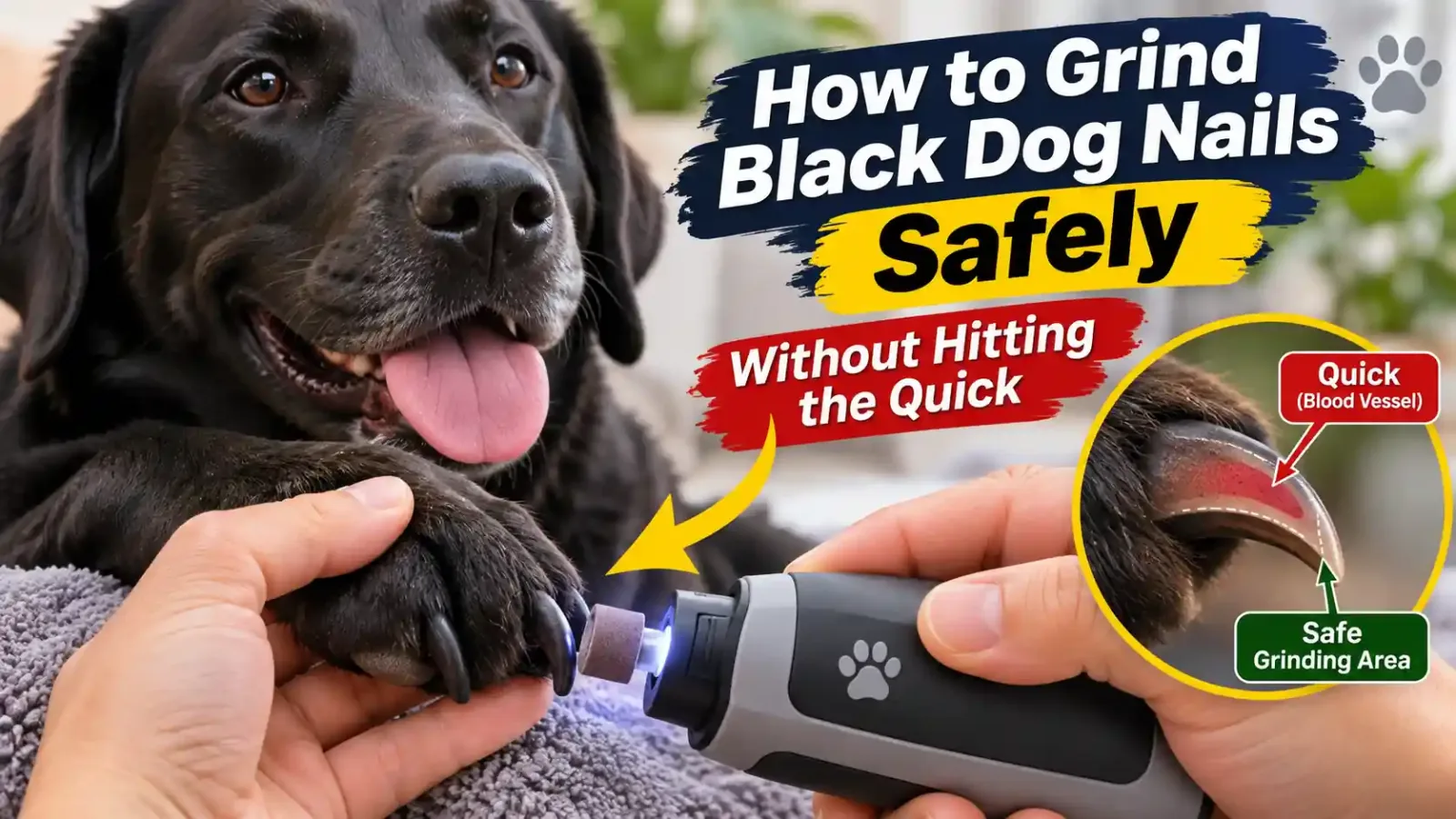
- Dark or black nails: Watch the end of the nail. When the dry, chalky white center turns into a moist gray or dark dot, stop.
Our guide on how far to grind dog nails shows these signs in detail; the same rules apply to filing. For dark nails, see how to cut black dog nails.
The target length: When your dog stands on a flat surface, the nails should not touch the ground, and you should not hear clicking on hard floors.
How to File Dog Nails With a Scratch Board
If your dog does not like having their paws held, a scratch board lets them file their own nails.
- Place the board flat on the floor and reward any interest in it.
- Put a treat under your hand on the board, so your dog paws at your hand to get it. Reward every scratch.
- Add a cue such as "scratch" once your dog paws reliably.
- Raise the angle by leaning the board against a wall, so your dog drags their nails down the surface.
- Build up to several scratches per treat.
Most dogs learn the front paws within a few sessions. Back paws take longer; some owners use a small handheld board under the back foot instead. Boards with a curved surface or a built-in treat box make training easier. See our best dog nail files guide for the scratch boards we recommend.
Filing After Clipping
Clippers leave sharp, sometimes jagged edges. A few strokes with a file after each clip smooths them out, protects your floors and furniture, and lowers the risk of the nail snagging and splitting. Many owners clip the length and then file, which combines speed with a smooth finish.
How Often Should You File Your Dog's Nails?
| Situation | Frequency |
|---|---|
| Routine maintenance | A few strokes per nail every 2 to 4 days |
| Scratch board users | A short session every day |
| After clipping | Every time you clip |
| Shortening long nails gradually | Every 2 to 3 days, so the quick can recede |
Frequent, short sessions work better than occasional long ones. They keep the quick short and make filing a normal part of your dog's routine.
Common Mistakes When Filing Dog Nails
- Sawing back and forth, which can split or fray the nail.
- Filing the top of the nail heavily, where the quick sits closest to the surface.
- Trying to shorten very long nails in one session. Filing is slow, so overgrown nails need several sessions or a clipper or nail grinder first.
- Forcing a frightened dog. Stop, go back to desensitization, or try a scratch board.
- Using a worn-out file or pad. A dull surface makes filing slow and frustrating.
- Skipping the back paws and dewclaws.
When to Ask a Vet or Groomer
- Nails are curled into the paw pads or very overgrown
- A nail is cracked, split or bleeding
- Your dog shows pain, limping or swelling around a toe
- Your dog is too fearful or aggressive to handle safely
A vet can trim severely overgrown nails safely, and then you can keep them short at home with a file. Our guide on how to cut dog nails without clippers covers other gentle options.
Not sure if filing is right for your dog? Read can you file a dog's nails? for the pros, cons and which dogs it suits best.
Recommended gear: best dog nail files · best dog nail grinders
Related guides: Can You File a Dog's Nails? · How Far to Grind Dog Nails · How to Cut Dog Nails Without Clippers
Trusted sources: How to Trim a Dog's Nails (VCA Animal Hospitals) · Handling Exercises for Trimming Nails (VCA Animal Hospitals) · How to Trim Dog Nails Safely (American Kennel Club)
Frequently asked questions
What is the correct way to file a dog's nails?
Hold the paw, press the toe pad to extend one nail, and file in one direction from the top of the nail toward the tip at about a 45-degree angle. Use short strokes, check the nail end often, and stop before the quick.
How long does it take to file a dog's nails?
With a diamond file, each nail usually takes 10 to 30 seconds of filing for maintenance. A full session for all four paws often takes 5 to 10 minutes. Very thick or long nails take longer.
Should I file my dog's nails wet or dry?
Dry nails are easier to see, but slightly damp nails, such as after a bath, are softer and file a little faster. Either works; just make sure your dog's paw is not slippery to hold.
Which direction should you file dog nails?
File in one direction, from the top of the nail toward the tip, following the natural curve. Sawing back and forth can fray or split the nail.
How do I file my dog's nails if they hate it?
Go back to short desensitization sessions with treats, file just one nail per session, and keep it positive. A scratch board is often the best solution for dogs that hate paw handling.
Can I file my dog's nails instead of cutting them?
Yes. Filing alone can keep nails at a healthy length if you do it every few days. It is slower than cutting, so very long nails may need clipping or grinding first.
Conclusion
Learning how to file dog nails at home is simple: get your dog comfortable, hold the paw steady, file in one direction at an angle, check the nail end often and stop before the quick. A few strokes every few days keeps nails short, smooth and healthy, with no noise and very little risk. Pick a file that suits your dog from our best dog nail files guide and start with short, rewarding sessions.